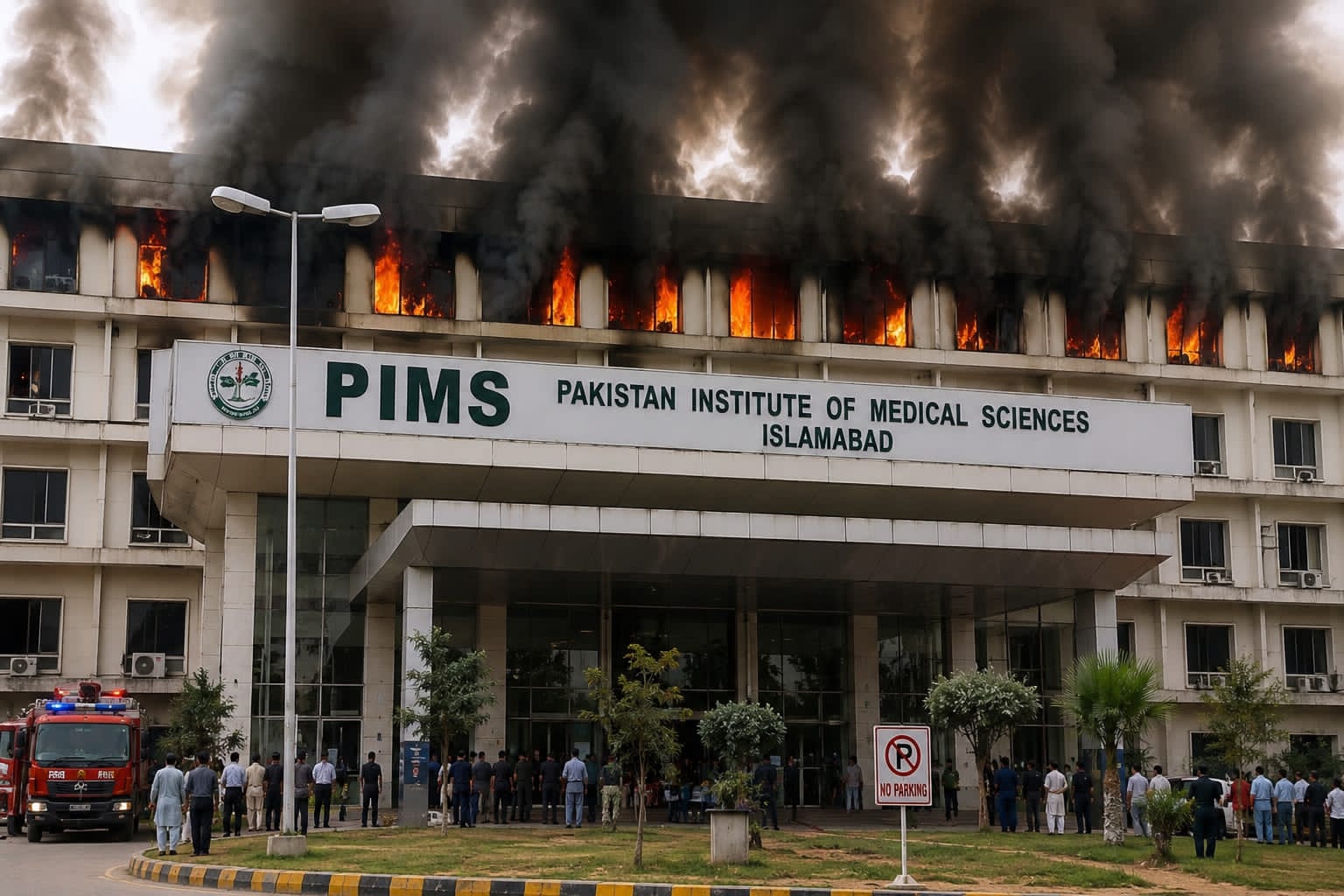
There are some tragedies that leave you speechless.
The death of newborn babies is one of them.
The reported deaths of 14 newborns at PIMS Islamabad are not just another news story. For most of us, these children were names we never knew and faces we never saw. But for their parents, they were everything.
A mother had carried that child for months. A father had probably imagined taking the baby home. Families must have been waiting for the day when they would hold their newborn without wires, tubes and hospital walls between them.
And then, suddenly, everything changed.
An initial electrical or air-conditioning fault has reportedly been considered among the possible causes of the fire. The final cause should be determined through a proper investigation. But regardless of how the fire started, one question keeps coming back:
How did so many newborn babies lose their lives in a hospital?
That is the question we cannot avoid.
A newborn cannot run away from a fire.
A newborn cannot open an emergency exit.
A newborn cannot scream for help in the way an adult can.
These babies were completely dependent on the people and systems responsible for their care.
That is why this tragedy deserves more than condolences.
It deserves answers.
Accident or negligence?
Of course, not every accident is someone's fault. Electrical equipment can fail. Fires can start unexpectedly.
But hospitals are different from ordinary buildings.
Hospitals are supposed to be prepared for emergencies precisely because they contain people who cannot save themselves.
Fire alarms, emergency exits, electrical inspections, firefighting equipment, evacuation plans, trained staff and regular drills are not luxuries.
They are basic safety requirements.
And if any of these things were missing, ignored or poorly maintained, then we have to ask whether this was simply an accident—or whether negligence turned an accident into a catastrophe.
This is where institutional incompetence, complacency and sometimes plain stubbornness become dangerous.
We have all seen it in our institutions.
A warning is given, but nobody takes it seriously.
A faulty system is reported, but the repair is delayed.
An employee raises an issue, but the response is:
"It has been working like this for years."
Someone asks for funds, and the file moves from one desk to another.
Someone recommends a safety measure, but it is considered unnecessary.
And sometimes, sadly, an official's ego becomes bigger than the problem itself.
Until something goes terribly wrong.
Other countries learned this lesson the hard way
In developed countries, fire safety is not treated as paperwork to be completed and forgotten.
Hospitals are regularly inspected. Safety responsibilities are clearly assigned. Emergency procedures are tested. And when serious negligence is established, people can face professional, financial and even criminal consequences.
In countries such as the UK and the United States, hospital safety standards include detailed requirements for fire protection, emergency exits, smoke control, alarms, evacuation procedures and staff preparedness.
The important difference is not that these countries never have fires.
They do.
The difference is that their systems are designed with one basic assumption:
A fire may happen. People must still survive.
That is the mindset we desperately need.
We cannot keep forming committees after people die
This is perhaps the most painful part of our system.
After a tragedy, there is usually a familiar sequence.
A statement is issued.
An inquiry committee is formed.
Officials promise action.
A few days pass.
The public forgets.
And eventually, the system returns to normal.
Until the next tragedy.
This cannot be the meaning of accountability.
If an investigation finds negligence at PIMS, responsibility should not automatically end with the person who happened to be on duty that day.
We need to look at the entire chain.
Who was responsible for the electrical system?
Who inspected the equipment?
Who was responsible for fire safety?
Were emergency exits accessible?
Were alarms working?
Were staff trained to evacuate newborns?
Were emergency drills conducted?
Were previous complaints ignored?
Did administrative delays contribute to the situation?
And most importantly:
Did someone know about a danger and choose not to act?
If the answer is yes, that person must be held accountable regardless of rank, position or influence.
Fourteen babies were not a number
This is perhaps what hurts the most.
We say "14 newborns" because that is how news reports describe them.
But there were 14 individual stories behind that number.
Fourteen mothers.
Fourteen fathers.
Fourteen families.
Fourteen futures.
Someone was waiting to give a baby its first proper bath at home.
Someone had probably already chosen a name.
Someone was waiting to introduce the child to grandparents.
Someone was planning a photograph.
Someone was simply praying:
"Ya Allah, bas mera bacha theek ho jaye."
And now those families have to live with a silence that no compensation can fill.
Please don't let this become another headline
The real test begins after the cameras leave.
An honest investigation must tell the public what happened.
Not a report written merely to protect institutions.
Not an inquiry designed to find a convenient scapegoat.
Not a suspension followed by silence.
We need the truth.
And if negligence is established, we need accountability.
Not because punishment can bring these children back.
It cannot.
But because perhaps it can save the next child.
The deaths of these babies should force us to look honestly at our hospitals, our safety standards and our administrative culture.
Because a hospital is supposed to be a place where people fight for life.
A neonatal ward should be among the safest places in the building.
And a newborn should never become the victim of someone's negligence, complacency, incompetence or ego.
Fourteen little lives are gone.
We owe their parents more than condolences.
We owe them the truth.
And we owe every newborn who enters a Pakistani hospital a system that is prepared to protect them.
May these innocent souls rest in peace and may their deaths finally teach us that safety cannot be treated as a formality.