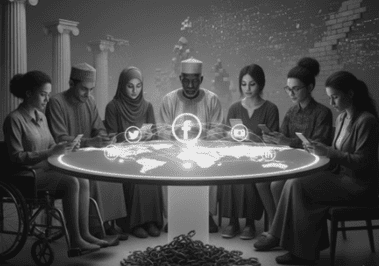
In the era of digitization, social media has emerged as one of the most powerful forces of present time. From a simple tool of communication, it has turned into a powerful platform that outdo geographical, cultural, and socioeconomic boundaries. Social media has made it possible that ignored voices are no more ignored, they are although heard and aggrieved ones are now consoled. In this sense, social media functions as an equalizer, reshaping power dynamics in society. At its core, social media serves as a powerful equalizer by equal access to information for everyone, louden marginalized voices, and creating opportunities in the digital economy. However, its full potential can only be cherished by addressing persistent challenges such as digital illiteracy, connectivity gaps, and algorithmic biases that threaten to undermine its inclusive promise.
The social media as an equalizer is clearly visible in its role in wake of global movements for justice. Movements such as BlackLivesMatter and MeToo demonstrate how global attention against chaos and injustice can be drawn regardless of social standings. These movements by the dint of social media have bypassed traditional media gatekeepers which always work at hands of some influential and have let common man narrate their own experiences.
Beyond activism, it has created numerous opportunities for financial independence. It has given financial literacy to an extent that for earnings and financial independence, very few rely on formal education for making money. Platforms like YouTube, Instagram and Ticktock etc have enabled content creators to be famous beyond borders. They through their following can easily seek PR packages, get opportunities in media houses in advertisements and even in serials. Social media platforms have opened corridors for new comers beyond borders where everyone with good content and out of the box ideas can easily make their places and become independent.
“Social media serves as a powerful equalizer by democratizing access to information, amplifying marginalized voices, and creating opportunities in the digital economy, though its full potential can only be realized through addressing challenges like digital literacy, connectivity gaps, and algorithmic biases.”
Social media serves as a platform that mobilizes resources for humanitarian causes. Previously, mobilizing people was an uphill task, with uncertainty about whether donated resources were reaching the deserving or not. However, social media has made this process more transparent and efficient: funds can now be transferred directly into accounts, and formal setups exist in the form of Facebook pages, official email addresses, and complaint boxes in offices. In addition, there are reporting mechanisms for fraudulent activities, enabling the public to identify and expose wrongdoing.
Social media makes cultural exchange and its understanding across borders in multiple ways. First, instant interaction removes geographical boundaries. People from different regions can communicate on social media applications and educate other masses about themes of their cultures and in this way learning from right people lessens biases against such cultures. Other than communication. By providing opportunities to express ones concerns, upload ones content and address objections, social media has proved to be the bridge between different cultures of the world.
Along with all these marvels of social media, there are certain challenges it has been associated with it which may hinder the say of equity. First, the digital divide remains a significant obstacle. Digital divide refers to the gap between people with modern technologies and those who lack them. Moreover, misinformation and cyberbully are the major threat to social cohesion. Social media has also proved to be a double-edged sword which on the one hand work as an equalizer and on the other, divides societies, defames individuals, and, in many cases, threatens lives.
To maximize potential of social media, expansion of internet access to countryside, providing digital literacy in order to use it effectively and ensuring implementation of ethical regulations are need of an hour. If we commit to the ethical values, address challenges associated with social media, and act as responsible citizens, social media can create even greater marvels.